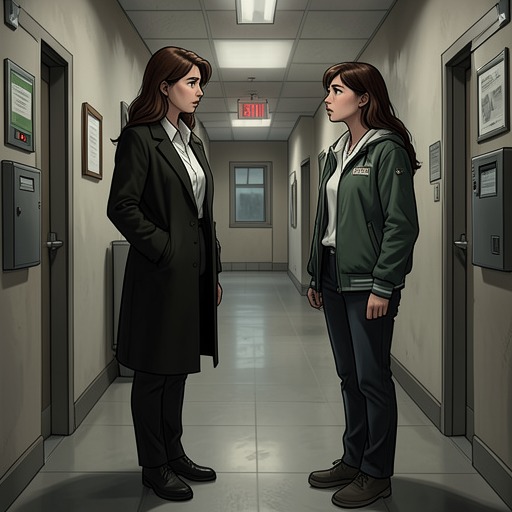
You never really understand a person until you consider things from his point of view—and climb into his skin and walk around in it
Freaky FridayThe expression “You never really understand a person until you consider things from his point of view—and climb into his skin and walk around in it” is both a passage from To Kill a Mockingbird and the central idea that gives meaning to Hadley and Ms. Pitt’s experiences. Its importance lies not only in what it says about empathy, but in the way the book makes its words echo across two moments: first as part of a faltering classroom presentation, and later as a lesson the characters have come to understand through experience.
Source and First Reading
Ms. Pitt gives Hadley her copy of To Kill a Mockingbird during Hadley’s presentation. When Hadley opens the book, it falls to page 138, where the passage catches her attention. She describes the experience as if the words had singled themselves out, while qualifying that impression as a feeling rather than a literal supernatural light. The scene presents the quotation as something Hadley encounters at a moment of personal difficulty, not as a line she has already mastered.
Hadley begins by explaining that the passage is spoken by Atticus, the father. She starts the quotation but struggles to continue. The interruption from a student in the back of the room, who makes a disrespectful remark about Hadley’s sister Tatum, is followed by laughter. Hadley drops the book and cannot finish the line. The quotation’s call to consider another person’s perspective thus enters a classroom where the immediate response to Tatum is reductive and objectifying, while Hadley is too overwhelmed to complete the lesson on her own.
Completing the Quotation
Ms. Pitt helps Hadley recover the dropped book and supplies the next fragment of the sentence. Hadley and Ms. Pitt then finish the quotation aloud together: “his skin and walk around in it.” The completion is a small, concrete act of support within a scene in which Hadley has lost her confidence. The words do not erase the interruption or make the presentation easy; instead, teacher and student speak the final thought in partnership.
That shared reading gives the expression a dramatic form. Hadley is not simply asked to explain empathy from a distance: at a moment when she is exposed to the class’s attention and struggling to speak, Ms. Pitt helps her continue. The passage’s movement from an individual attempt to a jointly completed sentence makes perspective-taking inseparable from the scene’s practical demonstration of care.
Recognition and Repetition
Later, Hadley asks Ms. Pitt what they had said earlier that morning. Ms. Pitt first jokes about their earlier exclamation that the situation was impossible, but Hadley clarifies that she means the quotation from To Kill a Mockingbird about seeing something from another person’s perspective. The exchange turns the line into a deliberate recollection: its words matter because the characters can now connect them to what they have experienced.
Ms. Pitt recognizes that school is not only about grades, but about learning. She reflects that reading the book and studying its vocabulary had not, by themselves, led her to absorb its meaning. After seeing things from a different perspective that day, she says she finally understands both the lesson and what the book is about. Hadley begins the quotation again; Ms. Pitt supplies the next fragment, and together they finish it. Their grins mark the difference between reciting a sentence and recognizing its meaning through experience.
Function and Significance
The repeated quotation gives the narrative a clear frame: an incomplete reading in the classroom is answered by a later, confident repetition grounded in changed understanding. The first scene places the words beside Hadley’s embarrassment and the class’s insensitive response to Tatum; the later scene presents them as a lesson Ms. Pitt has personally grasped. This contrast makes the expression a measure of learning rather than a decorative literary reference.
The line’s emphasis on considering another person’s point of view also connects the two characters’ shared experience to the book’s larger concern with empathy. The narrative does not treat understanding as something achieved merely by knowing the correct words. Hadley and Ms. Pitt complete the sentence together at the beginning, but its fuller significance becomes explicit only when Ms. Pitt recalls it and reflects on how seeing from another perspective has made a difference. The expression therefore links reading, lived experience, and the possibility of responding to others with greater understanding.